
Prakriti vs. Vikriti: Understanding Your Ayurvedic Constitution
Why Doesn’t the Same Lifestyle Work for Everyone?
Have you ever wondered why one person feels energetic after eating a particular meal, while another feels sluggish? Or why some people thrive in cold weather while others constantly seek warmth?
According to Ayurveda, every individual is unique. This uniqueness is understood through two fundamental concepts—Prakriti and Vikriti.
Although these terms sound similar, they describe two very different aspects of your health.
Understanding the difference between them is one of the first steps towards understanding Ayurveda itself.
What is Prakriti?
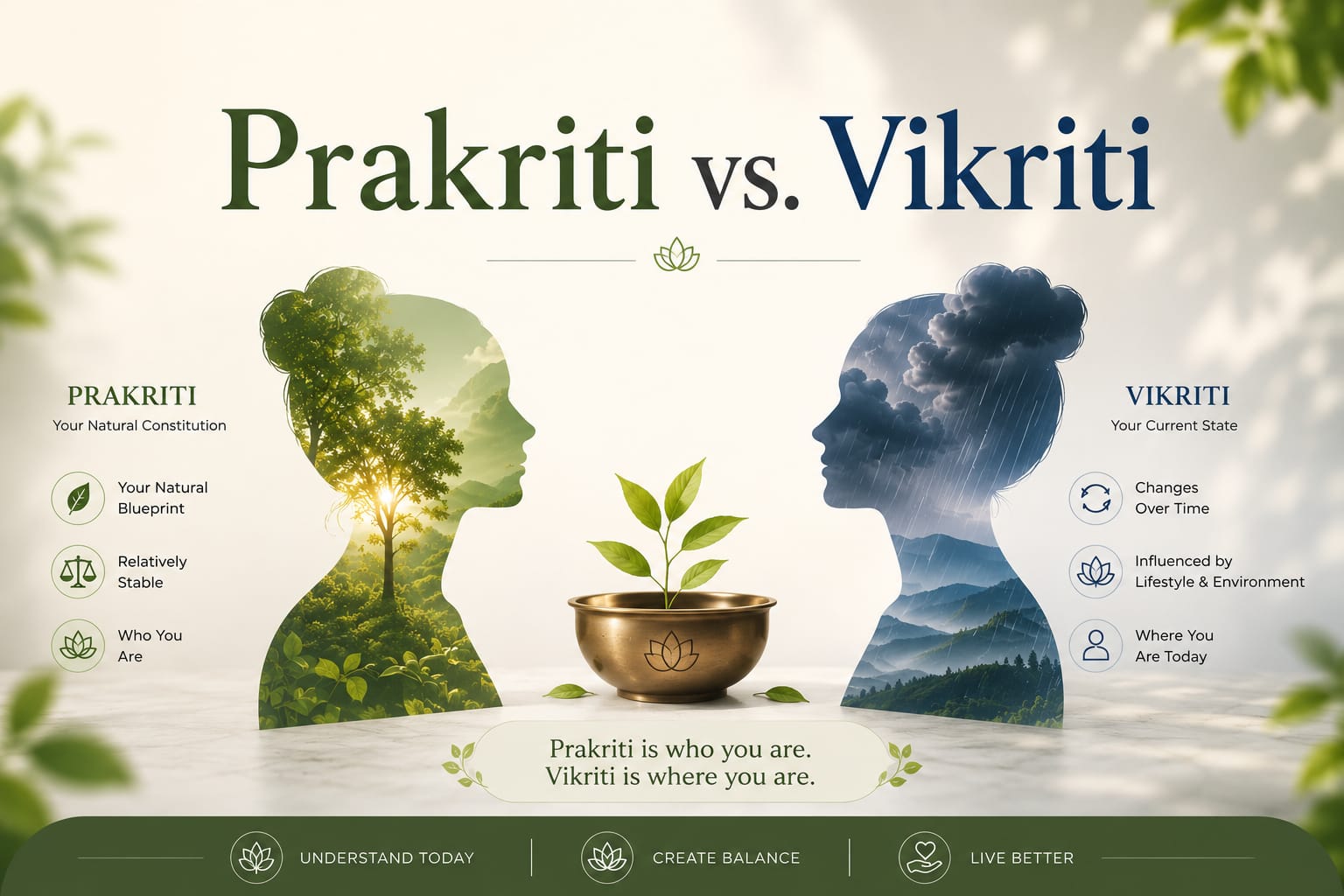
Prakriti refers to your natural constitution.
According to Ayurveda, it is established at the time of conception through the natural balance of Vata, Pitta, and Kapha. This unique combination makes every individual different.
Prakriti is believed to influence many aspects of your body and mind, including:
- Body build
- Digestion
- Energy levels
- Sleep patterns
- Appetite
- Emotional tendencies
- Response to different climates
Ayurveda considers Prakriti to remain relatively stable throughout life.
🌿 SARPL INSIGHT
Think of Prakriti as your body's natural blueprint according to Ayurveda. It reflects how your body and mind are naturally inclined to function—not whether you are healthy or unhealthy.
What is Vikriti?
If Prakriti is your natural blueprint, Vikriti represents your current state of balance or imbalance.
Unlike Prakriti, Vikriti is dynamic. It can change with time and is influenced by your daily habits, environment, and overall lifestyle.
Factors that may influence Vikriti include:
- Irregular meal timings
- Poor sleep
- Emotional stress
- Seasonal changes
- Illness
- Physical inactivity
- Overexertion
- Dietary habits
This is why your present condition may not always reflect your natural constitution.
Prakriti vs. Vikriti
| Prakriti | Vikriti |
|---|---|
| Your natural constitution | Your current state |
| Relatively stable | Changes over time |
| Present from birth (Ayurvedic concept) | Influenced by lifestyle and environment |
| Your natural balance | Your present balance |
Why Does This Distinction Matter?
Ayurveda does not believe that the same advice works for everyone.
Imagine two people with different constitutions following the exact same diet. One may feel light and energetic, while the other may experience bloating or discomfort.
Similarly, a person with a naturally Pitta-dominant Prakriti may temporarily develop a Vata imbalance because of irregular sleep, stress, or travel.
According to Ayurveda, recommendations are traditionally based on both your natural constitution and your current state—not on either one alone.
Can Prakriti Change?
According to classical Ayurvedic principles, Prakriti remains relatively stable throughout life.
Your habits, environment, and age may influence how your body functions, but they do not change your original constitution.
What usually changes is Vikriti—your present state of balance.
Can Vikriti Improve?
Yes.
Ayurveda believes that lifestyle, diet, daily routines, seasonal practices, and appropriate therapies can help support the body’s natural balance.
The goal is not to change your Prakriti but to help bring your Vikriti closer to your natural state.
Can You Have More Than One Dominant Dosha?
Yes.
According to Ayurveda, every person has all three doshas.
Some individuals may have one dominant dosha, while others may naturally have two doshas that are equally prominent.
For example:
- Vata–Pitta
- Pitta–Kapha
- Vata–Kapha
In some cases, all three doshas may be present in a relatively balanced state.
This diversity is one reason Ayurveda emphasizes personalized care rather than general recommendations.
Why Do Ayurvedic Practitioners Assess Both?
During an Ayurvedic consultation, practitioners traditionally consider both your Prakriti and your Vikriti.
Someone’s natural constitution explains how their body is designed to function, while their current imbalance helps explain what they may be experiencing today.
Looking at both provides a more complete understanding of the individual.
Can You Identify Your Own Prakriti?
Online quizzes can be an interesting starting point, but they cannot replace a comprehensive Ayurvedic assessment.
According to Ayurveda, determining Prakriti involves evaluating multiple physical, physiological, and behavioural characteristics. A qualified Ayurvedic practitioner can perform a more detailed assessment.
Common Misconceptions
Myth: Your Prakriti changes every few years.
Fact: Ayurveda considers Prakriti to be your natural constitution, which remains relatively stable throughout life.
Myth: Having a dominant dosha means something is wrong.
Fact: Every individual naturally has a unique doshic composition. A dominant dosha is a normal part of your constitution.
Myth: Prakriti and Vikriti are the same thing.
Fact: Prakriti describes your natural constitution, while Vikriti reflects your current state of balance or imbalance.
🌿 SARPL INSIGHT
Ayurveda does not seek to change your Prakriti. The goal is to bring Vikriti closer to Prakriti — that is true health.
Final Thoughts
Prakriti and Vikriti form the foundation of many Ayurvedic principles.
While Prakriti helps explain your natural constitution, Vikriti reflects how your body is functioning today. Understanding the relationship between the two is central to Ayurveda’s individualized approach to health and well-being.
As you continue exploring Ayurveda, you’ll find that concepts like the Three Doshas, Agni, Ama, Dinacharya, and Ritucharya all build upon this foundation.
Continue Reading
If you’re just beginning your Ayurvedic journey, these articles are a great next step:
The Three Doshas: Understanding Vata, Pitta & KaphaThis article is for general education only and is not a substitute for personal medical advice. Speak with a qualified doctor or pharmacist about your condition and medicine use.